01 · The Library — Climate & Overshoot
Glaciers Don't Melt Anymore - They Let Go
And Nepal just found out (again) how fast

The surveillance camera at the Rasuwagadhi border crossing catches it whole. People are walking between parked buses with luggage and passports, the ordinary scene of a land border, when everyone starts running in the same direction at once. Behind them comes a brown wall several stories high, moving at highway speed and devouring everything in its way. It picks up the row of buses and trucks and shuffles them aside like toys. Then the camera shows wreckage, and then nothing.
Forty miles south, in Kathmandu, needles jumped. The US Geological Survey logged a magnitude 4.4 earthquake near the border on Wednesday morning. Hours later it took the earthquake back. The seismic signal, it said, came from glacial ice and rock breaking loose and tearing down a valley, upgraded on review to a magnitude 5.2 event. “No earthquake had occurred,” they corrected.
Something heavier did.
At around 5,200 meters 17,000 feet) on a Himalayan ridge, the lower end of a glacier broke off and fell 1,200 meters 3,900 feet), a slab of ice wider than five football pitches laid end to end, gathering rock as it dropped and pulverizing itself into water with the force of its own fall.
What came out the bottom of that fall crashed into the Lhende River, crossed the border, and turned an ordinary morning into a disaster. So far, at least 390 people are confirmed dead and more than 1,300 are missing, a lot of them trekkers and pilgrims from all over the world headed for Mount Kailash, with bodies recovered hundreds of kilometers downstream and a barrier lake still dangerously bulging in Tibet as I write this. In a hospital bed below the flood line, a 68-year-old survivor named Keshav Prasad Baral told reporters that when the water rushed into their home he tried to grab his wife’s hand...and couldn’t. Hours later, a helicopter evacuated him. His wife is still buried under the mud.
I’ve written for years about the slow way glaciers change, their compounding bits of sea level rising, graphs that creep toward 2100. What happened here runs on a different clock: the mountain basically let go all at once. And that whiplash(slow-motion climate math versus a disaster in real time) is the whole story.
Sharing is caring (and freeeee!
A Compounded Chain Reaction
At first, everyone reached for the explanation Nepal knows too well: an earthquake. Officials pointed to an earthquake minutes before the flood, and the instinct made sense: the ground had shaken, the instruments said so, and in this country “the ground is shaking” carries a specific, earned terror.
One worker who got swept away and was saved by the branches of a mango tree said it hit “like an earthquake.” His body read the signal the same way the seismographs did. But both were wrong in the same instructive direction. Nothing underground had moved first. What the sensors picked up was the mountain itself breaking loose and roaring down the valley, announcing itself on instruments built to listen for something else.
Then people started checking the receipts from above.
Satellite imagery showed no major lake upstream of the flood path, so this wasn’t a glacial lake suddenly blowing out its “dam” (the disaster this same valley suffered just last August). Weather data showed no
brutal rainfall in the past week, so it wasn’t a cloudburst either. And once you cross those off, you’re left with the simplest and wildest explanation: the glacier itself broke loose. The falling ice and rock slammed into the Lhende River hard enough to dam the river briefly, and when the dam of its own debris gave way, all the backed-up water came rushing out in one shot.
Instagram post
One river gauge on the Trishuli showed the river rose nine meters in half an hour, a three-story building of water assembled in the time it takes to eat lunch. The same tributary has now flooded twice in fourteen months, for two totally different reasons.
But we’ve seen this exact movie before, frame by frame.
In February 2021, at Chamoli in the Indian Himalaya, 27 million cubic meters of rock and glacier ice came off a north face, the volume of more than ten thousand Olympic pools, and turned into a debris flow that destroyed two hydropower plants and killed more than 200 people.
When researchers reconstructed what happened, they found a pretty straightforward chain reaction behind warming that loosens these mountains in compounding ways:
As glaciers shrink, they stop “propping up” the rock around them.
Meltwater seeps into cracks and loosens things further.
And ground that used to stay frozen (nature’s cement) starts thawing, so boulders that were locked in place can suddenly move.
It’s like a freezer dying. Everything starts to soften, and the solid chunk of ice filling half of it for years can suddenly snap loose.
The Loudest Example of the Same Story
Most of us were taught to worry about glaciers in a slow and far away fashion. The ice melts a little each year, the line on the chart keeps inching up toward 2100, and the damage shows up as a few extra millimeters of ocean somewhere you’ll never see. It’s the kind of problem you can file away in your head, like retirement paperwork. The Himalaya just published the other schedule, the one where the same debt gets collected in forty seconds, in one brutal burst.
Both versions are happening at the same time, and both are speeding up. Since 2000, the world’s glaciers have lost about 5% of their ice. In the Hindu Kush Himalaya, the loss rate has doubled. Nepal alone has lost nearly a quarter of its glacier area in about forty years, and more than 160 small glaciers have vanished completely. And at 1.5°C 2.7°F of warming (where we’re hovering now and trending higher) half the world’s glaciers are already locked into disappearing. That’s the pension-fund version of the crisis, and it’s awful on its own.
But retreat isn’t a tidy shrinking. When glaciers pull back, they leave a mess behind.
For one thing, all that meltwater has to go somewhere. There are now over 110,000 meltwater lakes sitting up in mountain ranges, and they’re growing fast, about 20% more area each decade. Over 10 million people live downstream of places where one of those lakes could burst.
And it’s not just the water. When the ice retreats, it stops acting like a brace that was holding steep rock in place. So the mountains above roads, dams, and villages start getting more unstable, because all that infrastructure was built for the “old,” colder mountain.
You can see the pace of this in the recent highlight reel:
Marmolada Italy), 2022 a serac breaks off the Dolomites’ highest glacier on a hot afternoon and kills eleven hikers, an event researchers have now tied directly to warming.
Tracy Arm Alaska) , ten weeks after Blatten: a fjord wall in Alaska, undercut by a tidewater glacier that had retreated out from under it, drops 64 million cubic meters of rock into the water, twenty-four Great Pyramids in one shrug, and the wave that climbs the opposite cliff tops out at 481 meters 1,578 feet), taller than the Empire State Building. The fall rings seismometers as a magnitude 5.4. It kills nobody, because the 150-passenger cruise ship that visits that fjord was sitting just outside the mouth at the time. For 67 years, the record wave of this kind, at Lituya Bay, had a faultline earthquake for a trigger. The new second-place holder needed a glacier that was no longer there.
Same valley in Nepal, 2025 a lake in Tibet overflows and takes out the border bridge.
And now the Lhende, 2026, deadliest of them all, with the ice needing no lake and no storm, only gravity and a warm week that had melted the snow off the glacier days before it failed.
The neighborhood record makes the trend legible. This corner of the Himalaya has now logged a lake outburst in 2025, an ice-rock avalanche in 2024, and the catastrophic avalanches that came down on Langtang during the 2015 earthquake, each by a different mechanism, all from the same warming anatomy. In Sikkim in 2023, a single bursting lake took out a billion-dollar hydropower dam built directly in the runout path.
So yes, glaciers are still shrinking over years, but sometimes the “payment” comes all at once, devouring a valley in minutes.
Regional glacier mass changes and their temporal evolution from 2000 to 2019.
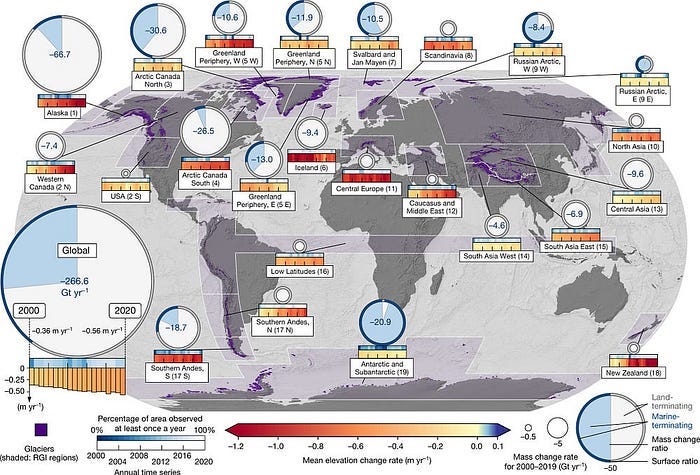
And this isn’t just some faraway crisis. I can literally see a version of it from my window in Patagonia. The mountain above my valley up in the Andes is called Tronador, “the Thunderer,” named centuries ago for the sound its hanging glaciers make when pieces let go and boom down the rock face. That name used to be just a colorful description. Now it feels like a warning label:seven of its glaciers are in retreat, in a region where nine of every ten glaciers are shrinking, shedding ice about as fast as anywhere on Earth.
The Himalaya is just the loudest example of the same story.
The Black Swan Over The Mountains
Plan the trek of your life with me.
Langtang, maybe, or the Kailash circuit, the one the pilgrims were queuing for. Watch how good you are at risk. You check the monsoon calendar and book the dry window. You check the seismic history and note the 2015 quake. You buy the insurance with the helicopter clause, pack the altitude meds, register with your embassy, download the offline maps, photograph your passport. Every danger you can name has a box, and you tick every box, because you are a careful person and this is the big one.
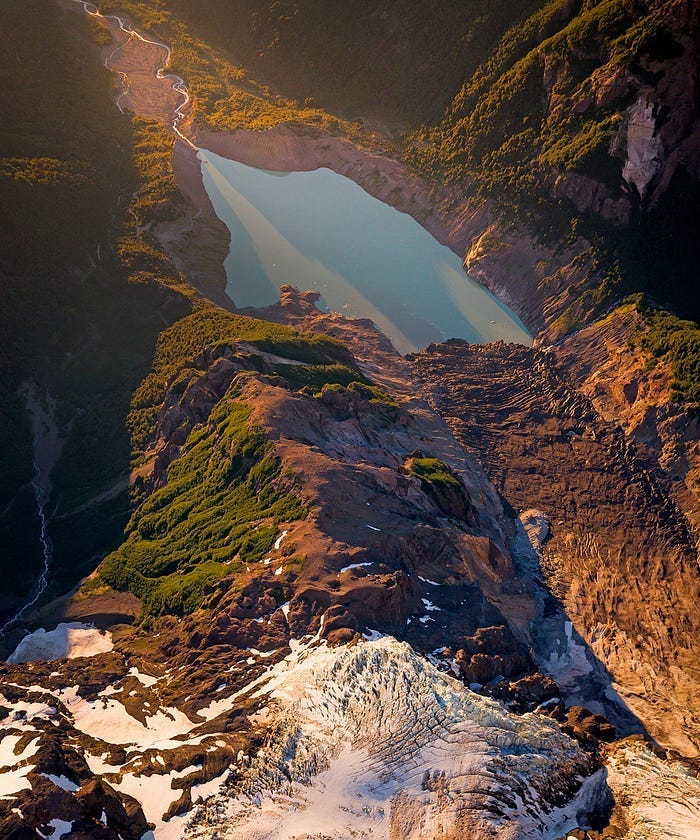
But now, there’s a question with no box: will the glacier hanging four vertical kilometers above the trail still be a glacier on the Wednesday you walk under it?
There’s no app for that, no forecast, no percentage, no premium. The monsoon has a season, earthquakes have building codes, altitude has a pill, and a mountain letting go has nothing, because every system we’ve built for pricing risk, from insurance tables to trekking permits to the siting of hydropower plants, assumes mountains behave statistically like they did last century and last week. The people at Rasuwagadhi probably checked everything checkable. The thing that killed them wasn’t on any form.
That’s what a black swan is: not an unimaginable event, an unpriced one. And this one has been circling for years, in Chamoli, on the Marmolada, over Blatten, getting photographed each time and filed each time under freak accident, while the freezer holding up the roof of the world keeps losing power.
Glaciers don’t melt anymore. That’s the old verb, from the old clock.
Now, they let go.
Sources
Every claim in a house essay carries a source. The number beside it in the catalogue card is counted from this list, so it appears when the list does. The full bibliographic records — author, year, publisher, DOI, and an archived copy so the footnotes do not rot — move across with the migration from Substack.